NOTE: This will take you about 15 minutes to read and look at.
I spent Monday working with a local publishing house carrying out a mix of consultation-via-workshop, in which by teaching my frameworks and case studies, we workshop the content and create a strategy for the company. It’s very much the same as what we did with the Finland Tourist Board at the Like Minds Summit last month.
True to form, the day is full of my hype oneliners. One of the main ones that I drill is “don’t target everyone, target the right ones”, which of course is about correctly understanding your community, and who the influencers within that community are.
What really irritates me is when I ask this question and then have to start from scratch trying to understand my community. That’s why I create models and frameworks: for my own use and my own sanity! However yesterday I realised that I haven’t really shared how useful this model below (The 7 Levels of Participation) has been for me with understanding communities.
For me, Social Media is about social, which is about relationship, which is about participation. Relationship is participation with one another. The deeper the relationship, the more participation we have with each other. Therefore I like to understand a community based on their varying levels of participation. If a community has higher levels, my strategy will fundamentally be different than if my community had low levels of participation.
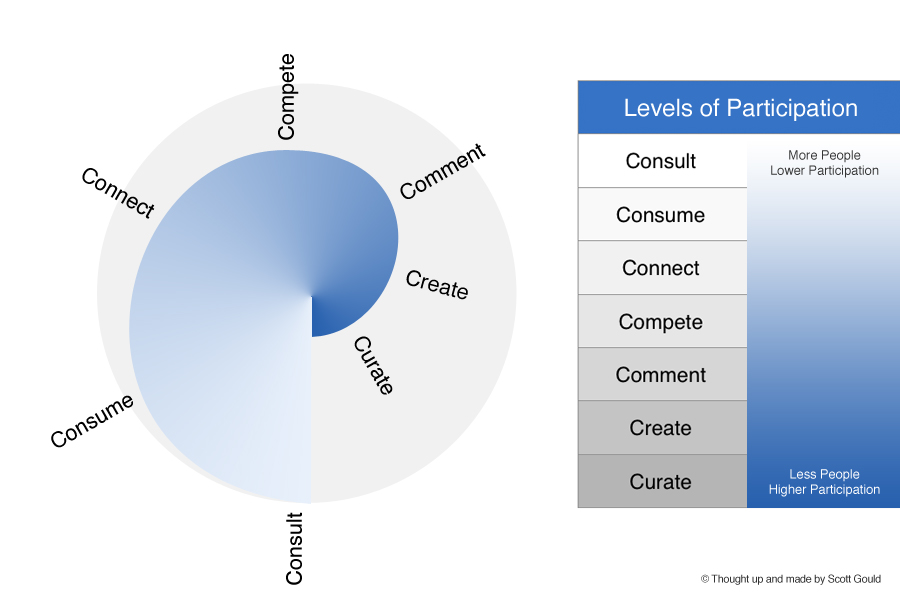
So, here is how I profile participation and then implement next actions based on that profiling:
1. Get My Stats
Obvious I know, but I have to get data in the door. I can’t just go on instinct or on the tidbits of feedback I have. It’s funny sometimes how one bit of customer feedback can change an entire decision, normally because we swell every bit of quantitive feedback we have in significance, because it’s often the only bit of feedback we get!
I make sure I have qualitative and quantitative data on my community, and many times you can use tools like TweetReports, Facebook Insights and PostRank (affiliate link) to get a good deal of your quantitative data and also seed feedback requests for your qualitative data.
Just the act of getting your numbers helps you get better perspective.
2. Generalise On My Stats
I use Forrester’s Groundswell Profile Tool which I enter the ages, genders and locations of my community into to get their generic profile types back. These types are linked to the 8 types on Forrester’s Groundswell Ladder.
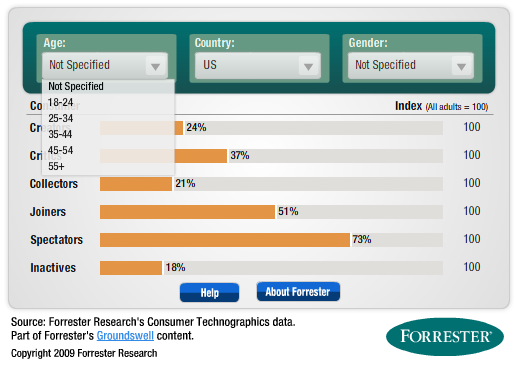
The groups that this tool returns (Contributors, Collectors, Spectators, etc) don’t map exactly to my model, which is fine. The point is, it gives me a very good general direction. This also raises the question of why you’d even use my model instead of Forrester’s. My reason is that the Levels of Participation is built specifically with participation actions in mind. So, as per my model, Comment, Consume, Compete, Create, etc are all actions that have pretty obvious tools connected to them.
3. Analyse My Stats To Actions
Now that I have profiles from Forrester linked to my stats, I begin to see where certain demographics will lie on my Participation Model. So, I know that my 18 – 24s, for instance, are more likely to be ‘Critics’ than my 55+ age group. However, the generalisms of this data aren’t always correct and don’t take my influencers into account either.
My next job is to analysis my stats, using the profiles from Forrester as a helping guide, and then link them to actions from the Participation Model. Here is where it becomes, hopefully, clearer as to why I have created this model.
If someone falls into Forrester’s ‘Critic’ field, what action is attached to that? We scratch our heads and begin to think. “Well, they could comment… they could rate something… they could like something… they could write a review.” And I know that around the world so, so many people are doing this – starting from scratch. The trouble here is that there is a vast difference between ‘liking’ and ‘rating’ and ‘commenting’, but Forrester’s tool doesn’t make that distinction for you (which of course it can’t.)
What I need to do is have a sliding scale of Social Media actions – going from the least participatory to the most participatory – with clear strategies and tactics linked to each of those levels. And that’s what my model does for me.
So now what I do is see how many operate at these levels:
- Consultation. How many are just looking? (Google Analytics mainly)
- Consumption. How many are regular readers and might have subscribed? (Returning Visitors in Analytics, Feedburner)
- Connection. How many follow, have created accounts, and joined a newsletter? (Profile followings, signups, newsletter stats)
- Competition. How many ‘like’, share, rank, rate and play any competitions or games that I have created? (Facebook, custom built stuff)
- Commenting. How many comment, @reply, use a #hashtag, retweet and share with additions, on what I’ve created? (Postrank, Facebook insights, Tweetreports)
- Creation. How many write about us? (Google blogsearch)
- Curation. How many are pulling this data together for me and joining my dots for me? (Relationship, and pretty much relationship alone)
4. Next Actions
Now that I know what the community is doing and how they participate, I can help them do more of it, seek to fill the gaps, better enable them, etc.
The big benefit is that if the community does a lot of consumption, but not much creation, then I know I shouldn’t spend all my resources on trying to get them from a level 2 to level 6. But I see people make this mistake all the time – the overestimation of participation – where they expect hundreds of people to just ‘send in photos’ or ‘write comments’ without knowing if and how these guys participate.
So if the majority of my community are consuming, then I might want to find ways to get others to consume through their consumption (share buttons, for instance.) If I want to up their level of participation, I need to find a way to convert their consumption into a connection. If I can get them to like my Facebook page, then all their friends will see they’ve liked it, so that’s a useful connection to make.
This is more meaningful than just trying to ‘get them to comment and share their photos’, which whilst young people are more readily prepared to do, most won’t for a brand (they’ll just do it for themselves), and most over 34s aren’t to keen on it either.
Your Leading Thoughts
Here is where the hard work begins because we then have to implement our strategies and ideas. I also have further things to share on where I take it from here, but until then, I’m keen to get your feedback and hear your leading thoughts.
- I don’t expect you’ve used this model – but what models have / do you use for profiling?
- Is participation the main thing that you want to measure? It is for me, but am I being idealistic here?
- Can you go away and use this approach tomorrow? If not, why?
Archived Comments
-
http://www.wavespr.com/
-
http://twitter.com/Malcolm12boxes
-
/
-
http://www.wavespr.com/
-
http://twitter.com/Malcolm12boxes
-
/
-
/
-
http://www.sytaylor.net
-
/
-
-
http://www.sytaylor.net
-
/
-
/
-
-
/
-
-
/
-
http://jeffhurtblog.com
-
/
-
http://jeffhurtblog.com
-
/
-
http://www.kristofcreative.com
-
/

Comments