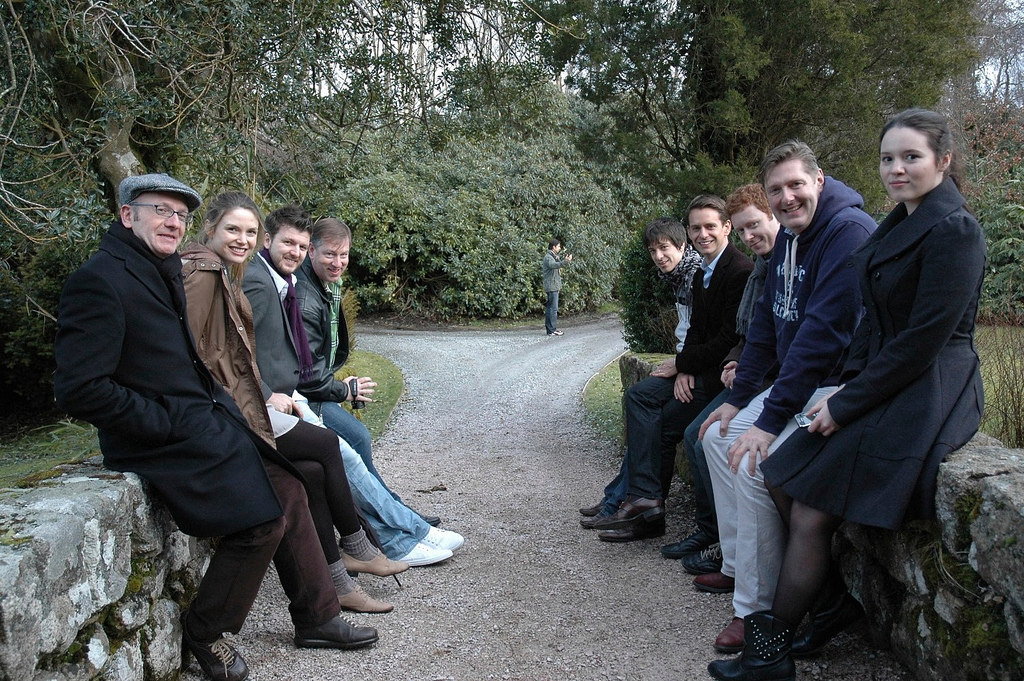
The Dream Team – hanging out with some of the people at the Like Minds Summit 2010 at Bovey Castle.
Around the end of the last year I wrote a series of posts on ‘free from the factory‘, in which we talked about the shift from an industrial economy to a knowledge economy, and the change in business and society that followed.
The main point is that in a knowledge economy you don’t manage people like parts in a machine – you lead them and guide them, because unlike parts in a machine, they have the ability to develop and grow, rather than rust and break. It’s this difference in mindset, between managing production and leading people, that is the reason why most companies don’t get it.
The organisations that will thrive and are thriving are people-to-people. They value people, not parts. The news yesterday was that YouTube now has 2 billion views a day. Facebook is about to hit 500 million users. What causes their success? Factories that churn out products faster and cheaper (the way we compete in an industrial age), or are they teams of very skilled, highly motivated people whose synergy and vision creates communities and platforms with depth that better provide customised experiences that meet the emotional needs of other people (the way we compete in a knowledge age.)
What Separates People From Parts?
- Parts need replacing to be better. People can learn new skills and develop themselves to become better.
- Parts are designed to do one function. People can multi-task and have multiple facets.
- Parts can’t create people. People can create parts.
- Parts can do reproduction of tasks. People can create new tasks for parts to reproduce.
- Parts clone. People customise.
- Parts create volume. People create value.
Practically Investing In People
When we talk about innovation, people-to-people is perhaps one of the biggest fronts that it is happening on. Not because people haven’t always been important – but never before have people been this important. To compete on industrial differences – availability / cost / quality – is a hard game to dominate, especially if you are starting out. Costs have been driven so low that products and services are mostly commoditised.
Everything rises or falls on the leadership of your team. The way to differentiate is in your people. How?
- Make self development part of the job. Create a culture of reflection and improvement.
- Remove the one-function wizards. Create opportunity and exposure for new experiences – so that your team can apply their real asset to more situations.
- Emphasise creativity. Expect people to create parts to replace what they used to do, so that they have time to innovate themselves.
- Review how you do things, and get your team to observe and feedback on daily lessons. Have weekly “what did we learn” meetings to report findings.
- Have your team figure out how to customise what you do to deeper levels. Let them write case studies.
- Emphasise value in your language – show they how create an asset they are.
Being a leader of many teams for many years, I can attest to these things working. I just wish I had done a lot of them sooner.
The Main Point
You need to have a strong team, not a faster machine.
Your Leading Thoughts
- What is the greatest thing you have done with a team of people? What is the lesson there?
Archived Comments
-
http://www.sytaylor.net
-
http://radsmarts.com
-
http://www.sytaylor.net
-
http://radsmarts.com
-
/
-
http://www.rosagarriga.net
-
/
-
http://www.sytaylor.net
-
/
-
http://www.sytaylor.net
-
http://www.rosagarriga.net
-
/
-
/
-
http://www.rosagarriga.net
-
/
-
http://www.rosagarriga.net
-
/
-
http://www.danblank.com
-
/
 )
)

Comments