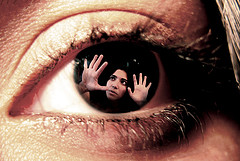
The Internet and Mental Health

The Prison •.On Thursday 10th March 2011 I’m speaking at the first European Conference on the Internet and Mental Health (website here), held in my home city of Exeter. The event is being organised by Tobit Emmens, who is the R&D Manager at Devon NHS Trust amongst other things.

I’m of course honoured to be asked to deliver a keynote, and whilst I’m not yet sure on the exact subject that I will be requested to speak on, there is no doubt in my mind that I’d like it to be an example of community by crowd sourcing parts of the content, much like I did when I spoke at Dicole Oz in Helsinki in June.

So let me turn this blog post completely over to you. Shout out your thoughts – whether them seem obvious or not, deep or not, useful or not – and let’s crowd source this content so I can share you insights with the a crowd of very smart NHS people who are hungry for your expertise.

(I’ll post more info as I get it regarding dates of the event, and I’ll summarise our thoughts in the comments in further blog posts.)

Your Leading Thoughts

To get you started, here are some questions that you could launch from:

  1. What is the first thing that you think when you hear “the internet and mental health”?
  2. What are the benefits of the internet for good mental health? What are the negatives?
  3. How has the internet changed your mental state and wellbeing, and even helped you through hard times like depress?

Really cool photo courtesy of Felipe Morin

29 thoughts on “The Internet and Mental Health

  1. I guess the internet can provide an 'alternative' to actual meaningful conversation with other people, which we all know is probably not the best thing. But of course this is entirely dependent on the person in question…

  2. The first thing that came to mind was physical isolation – virtual community.How 'healthy' is it for us to foster friendships virtually which in some cases are never consolidated with an off-line meet-up? I think much can be said about mental 'narcissism' when we fight to have the most facebook friends (for example) yet actually only converse with fifteen of them regularly. You could definitely integrate your value vs. volume framework on this topic as an antidote to this internet malaise.And, on another note, there is a whole wealth of literature that is bemoaning how spending time on the internet makes us:Illiterate (see this very reputable source of medical knowledge! > http://bit.ly/9CSQzI) Attention Deficit and 'shallow thinking' (http://bit.ly/96E71T)Affects how we write and appreciation of well-written English (http://thegauntlet.ca/story/8406)Etc. I'm sure that there is a myriad of literature and research to the contrary, but I expect these are some of the objections that might be raised.

  3. All the leaves are browning, and the sky is grey… I went for a walk, on a winters day… I'd be sleeping warm, if I was in LA… California dreaming, on such a winters day…*Ahem*. Sorry I felt like serenading you, while wearing my cat.Ok now for something constructive. The internet amplifies everything. The concept of tribes being able to meet around their subject means that if you were predisposed to (for example) anorexia, now you have a support community online. This is both good and bad. Has the internet allowed mental health issues to flourish?Ultimately the internet is an amplifier for humanity. It's easy to get lost in such a big detailed web where you can find just about anything you want. I like the phrase infoguilt. Has the internet made focus more difficult?The flip side of the coin is that the internet gives us access to the best knowledge and information on a given subject to improve our lives. Places like this blog drive a conversation where we can reach out to #likeminds. I'm sure some digging will help you find an equivalent community for those with mental health concerns?Certainly the open nature of dialogue on the internet has helped bring down some barriers and taboos. I'd be tempted to explore the pro's & cons with case studies, then deliver conclusions as actionable steps for how to successfully manage mental heath individually and institutionally.Happy to help if I can :)

  4. Hi Scott,I only had a spare 2 minutes so sorry I don’t go into much depth but these are the first things that spring to mind from my personal point of view. 1. Too much time spent on the internet can affect mental health.2. The internet makes it easier for people to learn about mental health and for studies to be shared. 3. The internet can cause my attention span to decrease and for headaches to occur. In hard times, very rarely would communicating through the internet help – physical human connections or simply being on my own would personally benefit me more.Good luck with the talk!

  5. Robert. Interesting thoughts.1. How do you think the internet itself affects mental health. As an extension of human society it is an outlet for mental health issues, but does the actual use of the internet have any affects on a healthy, “normal” person?2. I'd agree, do you think this can be double edged? People can learn bad behaviour from the internet too.3. Infoguilt is interesting. Is the addictive nature of having all the worlds knowledge at your finger tips affecting our happiness negatively?

  6. I saw Tobes yesterday and it might be that we'll be involved too Scott – would be good to work with you on, not one, but two truly international conferences in Exeter :)

  7. Hi Scott, congrats to you and thanks for sharing! Just a quickie, based on my recent experiences (remember my friend defending her Down sister?)1. Peer support, letting some steam out, chance to get heard, sharing experiences and getting comfort – on the bright side =)2. Collaboration at its best fortifies your personality, gratifies the effort, urges to share and blossom3. Finding a community to share value with allows you to neglect the one that doesn't approve collaboration and is, thus, a taker, not a giver.

  8. hey Scott, great post (!). seriously, thanks.OK, one of the things I am interested to hear more about is an exploration of the counter-side of the argument that the 'internet makes people stupid'what do I mean. I read countless articles (e.g. front page of the Saturday Times Review 14/08) that talk about how the internet has changed everything, largely for the worse. People no longer know how to read books, dig below the surface, etc. I imagine similar conversations were had (and shared orally) when the printing press booted into life c1500. Blasted thing will destroy community… and take away power / give it to the people etc. (sorry, I am wittering) So, as we cannot escape the internet has changed pretty much everything I want to hear about how we need to cast the future in the light of the last 10 years, rather than the light of the last 50-500!hoping that at least some of that makes sense!

  9. This is an interesting comment, Keri. Scott and I have been building our excellent friendship for over a year now – virtually. We have never met non-virtually. It has been incredibly fulfilling – and wouldn't have happened without the Internet. Is it enough? It is what it is.Best, Robin :)

  10. Hey Jonny

    Thanks for pointing these out – will check them out.

    I would ask another question: how many people have virtual friendships? Who, other than the early adopters who use Twitter, have virtual friendships? They just talk with their friends on Facebook or MSN, right?

    Scott

  11. I think point 2 is the most pertinent. Spending too much time on the internet and the causes this can have on health are things that boil down to an individuals actions and will be very hard to have any impact on in the short term, even using the viral effect of social media. They can be explained but can they be changed? Can you image making a dent on an issue like this?! Using social media to collaborate and learn (point 2) might at least allow little bits of progress to be made in some areas. People at the conference, and maybe watching from home, might be able to make develpments by working together using social media in ways that they were not previously aware of.

  12. Hey Tobit

    Thanks for giving some more direction to this – this certainly helps.

    So “as we cannot escape the internet has changed pretty much everything I want to hear about how we need to cast the future in the light of the last 10 years” – in what areas practically? I get the feeling that I could discuss this many ways… :-)

    Scott

Leave a Reply

Your email address will not be published. Required fields are marked *

*

You may use these HTML tags and attributes: <a href="" title=""> <abbr title=""> <acronym title=""> <b> <blockquote cite=""> <cite> <code> <del datetime=""> <em> <i> <q cite=""> <strike> <strong>