Last week I attended the launch night of Carluccio’s in Exeter. I got to talking with the PR guys who had handled the event about my freshly released New PR in 2010 framework, and to illustrate the point, I conducted a little test. I quickly tweeted if anyone had anything to ask the people at Carluccio’s, and within seconds I had responses that kept coming for ten minutes or so. I was able to show to the PR guys that there had firstly already been a conversation about Carluccio’s taking place earlier that day, and that I was able to obtain instant reviews and carry out realtime customer service, with very little effort. You can see the tweets here.
Today I want to show why real time micro media is so important, using my framework from last week.
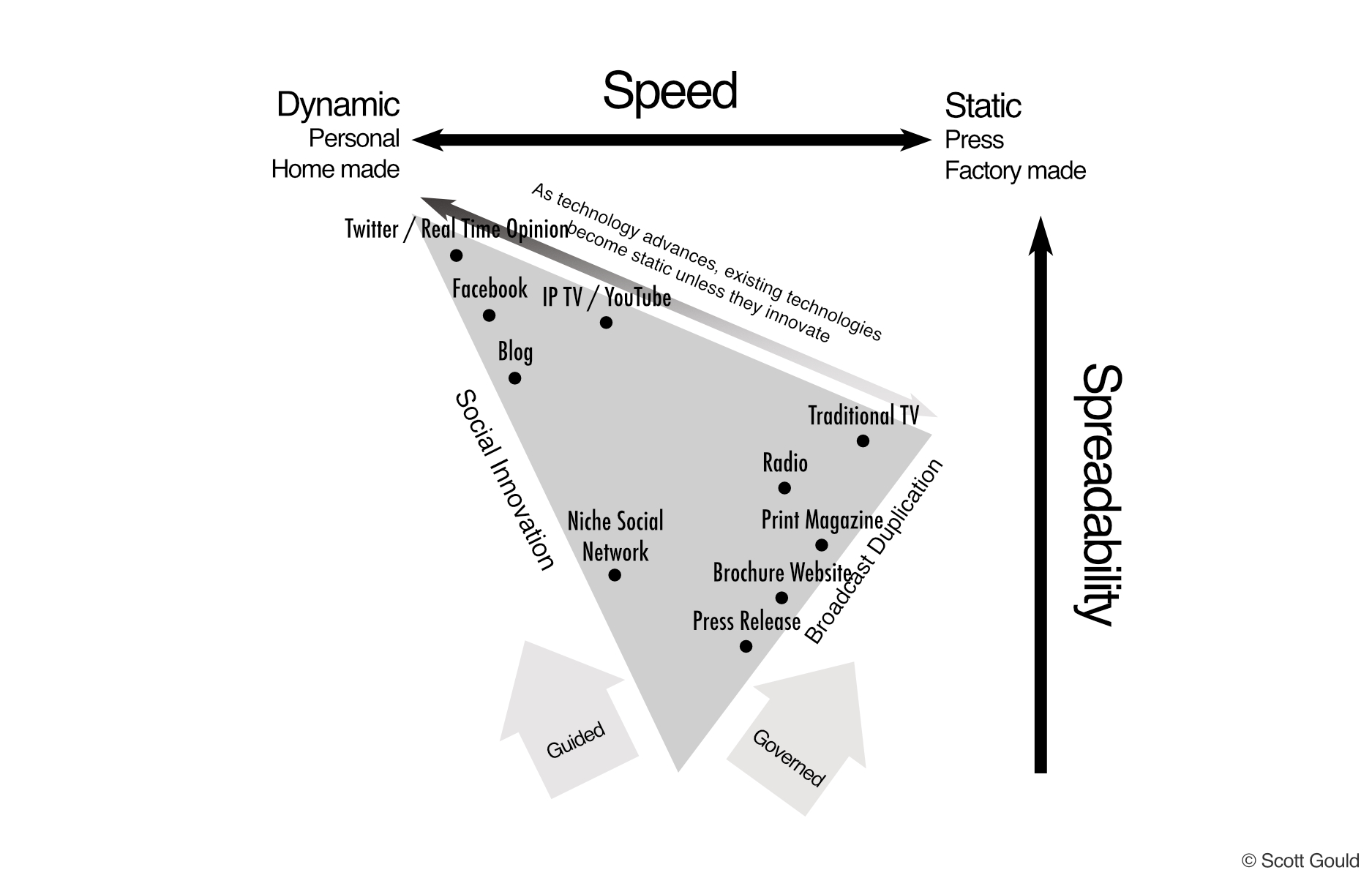
The model above illustrates the link between spreadability and relevance, measured from static to dynamic. My point is that as technology advances, existing technologies become more static. This means that the difference between static and dynamic is comparative between old and new technology.
As I did last week, let’s take TV as our example. Initially, TV was exceptionally dynamic in comparison to radio and/or theatre. Theatre was fixed to a location, and radio was fixed to a single sense. Television lifted these restrictions by providing entertainment and information without the need to be at the source and instead allowing access from the comfort of your own home, and without the need to supplement what was heard with images produced in their own imagination. Previously, location was governed; now location was guided because individuals could be entertained and informed wherever the user desired (to a certain degree.)
As tapes, and later DVDs, were introduced, this newer technology made TV in its existing form more less dynamic and more static. The medium of tape allowed people to record programmes and play them when they desired to, as well as hiring or purchasing other recorded videos. This lifted the restriction of time, because the viewer no longer had to watch when the programme was aired. Time had previously been governed, but now it was only guided. And so it continues:
- Cable and satellite increased the number and therefore lifted the restriction of channels, and increased variety. At this point, terrestrial television became, like, so last season. And again, the number of channels means that the choice is less governed and more guided.
- Built in DVD, VCR, Freeview, etc, lift the restriction of dependencies, because they are built into the device.
- Hard drive recording on satellite and cable devices lift storage restrictions.
- IP TV lifts device restrictions, as you now watch the programmes on your laptop, mobile phone, etc.
- YouTube lifts even further time, device and channel restrictions.
Track back over each of these iterations of television and you will also note that each advancement increases the spreadability (ease of access, ease of use, ease to share) of television by becoming more dynamic, more customised, and therefore, more personal. And with each restriction that is lifted by the enabling of new technology, the less governed and more guided it becomes.
The more dynamic and therefore personal a technology is, the more spreadable it becomes.
Applying This To Small Business
I’ve said it again, and again, and again, that mobile technology will merge offline and online together. Recently the User Experience consultant Darren Smith wrote about Foursquare and the ubiquitous world of the future, and how social media technology is enabling real life interaction. I totally agree.
As in Darren’s article, as per my test at Carluccio’s, as well as the recent Exeter Tweetup, and in running Like Minds, real time micro media is a shinning example of guidance over governance, and the resulted spreadability, and the convergence of two opposites of on- and off-line becoming one.
This isn’t for everyone. But for the innovative few out there: by customising your offering through being more personal and more dynamic, by lifting the restrictions that your static competitors fix their customers to, you gain market differentiation and offering a far more compelling experience by creating an alternate, dynamic reality from the existing static one.
Phew! Quite a statement. To illustrate, consider the following restrictions pertaining to micro media and how they can be lifted:
- Location. How can you provide high level of support wherever your customer is? Your static competitors require a phone or website – they haven’t even considered a tweet or facebook from a mobile phone.
- Time. What happens when your customer is frustrated and it’s out of hours? Your static competitors are sleeping, not tweeting.
- Device. Do you have mobile friendly portals for all devices? Your static competitors, if not friendly to none, are friendly only to the device they use.
- Channel. Can you be found on whatever social network and micro media your customer prefers? Your static competitors, if they don’t just snub social media right out, probably only have a dead Facebook group at best.
- Dependencies. Do you offer a simple and complete service, from start to finish? Do you have procedures to get the info you need in a few 140 messages? Your static competitors require signups, feedback forms, and long processes – all of which just frustrate an already frustrated customer.
By lifting static restrictions, you increase your ease of access, ease of use, and importantly, ease of shareability. As in the Carluccio’s test, realtime reviews come hard and fast, and a dynamic, personal experience will produce positive reviews that will be instantly shared.
Archived Comments
-
http://twitter.com/alexthegreen
-
/
-
http://twitter.com/MartinHowitt
-
/
-
/
-
http://twitter.com/alexthegreen
-
-
http://twitter.com/MHowitt
-
-
http://twitter.com/MHowitt
-
http://twitter.com/MHowitt
-
-
http://widget.xssl.net/~admin228/graphic-design/
-
http://widget.xssl.net/~admin228/graphic-design/
Comments